 Christian Foundation
Article
How old is the Universe
By Christian Foundation · October 14, 2026

The church has been reading Genesis 1 carefully, and differently, for nearly two thousand years.
How Old Is the Universe? What Christians Have Said, and Why We Stay One Body
Ask a room of faithful Christians how old the universe is and you may hear two answers separated by a factor of two million: about six thousand years, or about 13.8 billion. Both answers come from people who love Scripture, confess the Creed, and would die for Christ. That alone should tell us something about where this question sits.
This is not a new argument. The church has been reading Genesis 1 carefully, and differently, for nearly two thousand years. Here is that conversation, from the early church to the James Webb Space Telescope.
What every side affirms
Before the differences, the common ground. Every view below holds that God created all things from nothing (Hebrews 11:3), that Genesis is inspired Scripture, that humanity bears God's image, that the Fall was real, and that Christ is the answer to it. The Nicene Creed confesses God as "maker of heaven and earth, of all things visible and invisible." It does not say when. Neither does any of the historic creeds.
The early church: no single reading
The earliest Christians did not agree on how to read the six days, and they said so openly.
Theophilus of Antioch (c. AD 180) calculated the years from creation to his own day and arrived at roughly 5,700 (To Autolycus 3.28). He read the genealogies as a chronology, much as young-earth Christians do today.
Basil the Great (c. AD 370), in his sermons on the six days, defended reading "evening and morning" as a single day, a span of twenty-four hours (Hexaemeron 2.8).
Origen (3rd century) asked how there could be a first, second and third "day" with evening and morning before the sun was made on the fourth, and concluded the text was pointing beyond a plain chronology (On First Principles 4.3.1).
Augustine (early 5th century) went further. In The Literal Meaning of Genesis he argued that God created all things at once, and that the six days are a way of teaching the order of creation rather than its duration. Yet the same Augustine held that the world was less than six thousand years old (City of God 12.10). He did not read the days as twenty-four hours, and he did not believe in an old earth. He simply does not fit either modern camp.
The lesson from the fathers is not that one side was right all along. It is that sound, orthodox teachers read this chapter differently from the beginning, and the church never made it a test of fellowship.
The Reformation to the 1800s
Luther and Calvin both read the days as ordinary days and assumed a young world. In 1650 Archbishop James Ussher dated creation to 4004 BC, a figure later printed in the margins of many English Bibles.
As geology developed in the 1800s, faithful theologians re-examined the text. Charles Hodge of Princeton allowed that the days could be read as long ages. B. B. Warfield, among the most rigorous defenders of biblical inerrancy in American history, accepted an old earth and saw no conflict with Scripture's authority. Others proposed a "gap" between Genesis 1:1 and 1:2, popularized by the Scofield Reference Bible.
The modern conversation
Today the main positions are well developed, and each has serious defenders.
Young earth. Six ordinary days, a creation roughly 6,000 to 10,000 years ago, and a global flood that shaped much of the geological record. Its modern form was shaped by John Whitcomb and Henry Morris in The Genesis Flood (1961) and is championed today by ministries such as Answers in Genesis and the Institute for Creation Research. Key text: Exodus 20:11, "in six days the Lord made heaven and earth," the basis of the Sabbath command.
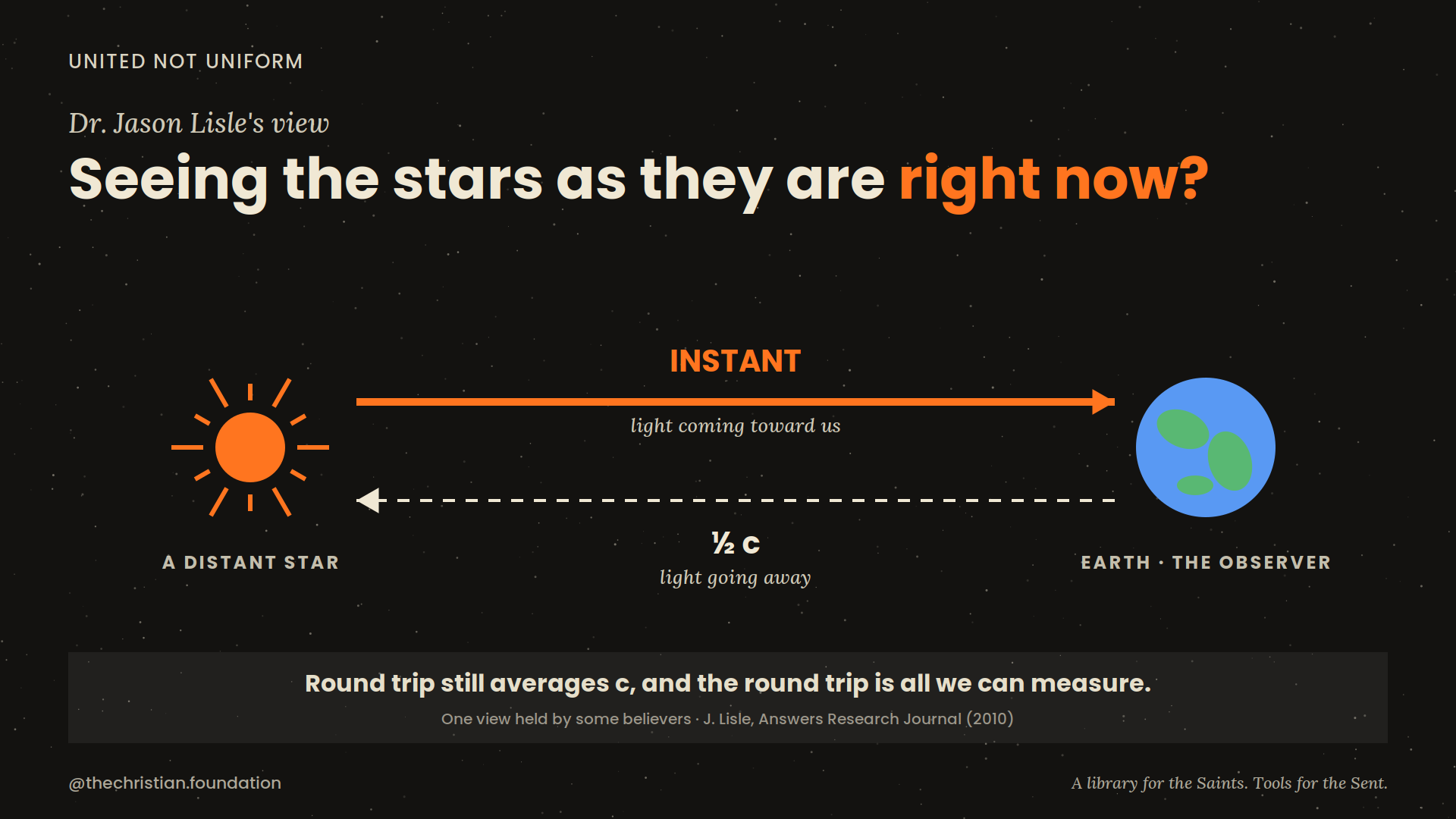
Because no one can measure light’s one-way speed, only its round trip, Dr. Jason Lisle argues that we may set our clocks so light reaches us instantly, which means we see distant stars as they are right now, not as they were billions of years ago.
Old earth, day-age. The days are long, sequential periods, and the universe is about 13.8 billion years old. Hugh Ross and Reasons to Believe are the best-known advocates. Key texts: Psalm 90:4 and the use of "day" for an extended period in Genesis 2:4.
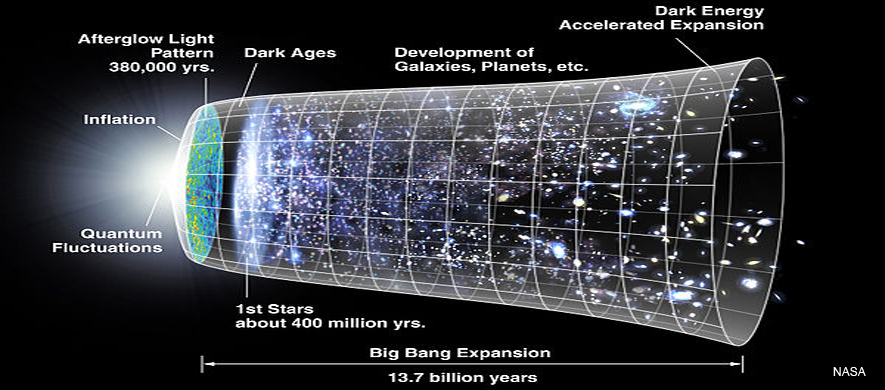
Framework and analogical readings. Genesis 1 is real history told in a deliberately structured, literary form. Days one to three form realms and days four to six fill them. Meredith Kline and Henri Blocher developed the framework view; C. John Collins argues the days are God's workdays, analogous to ours. John Walton reads Genesis 1 as God inaugurating creation as his temple. John Lennox's Seven Days That Divide the World (2011) is a short, gracious introduction to these options.
A bridge from physics. Gerald Schroeder, an MIT-trained physicist and an Orthodox Jew, offers a proposal many Christians have found striking. Genesis, he argues, describes time from the perspective of the beginning, looking forward, while cosmology measures it from our perspective, looking back.
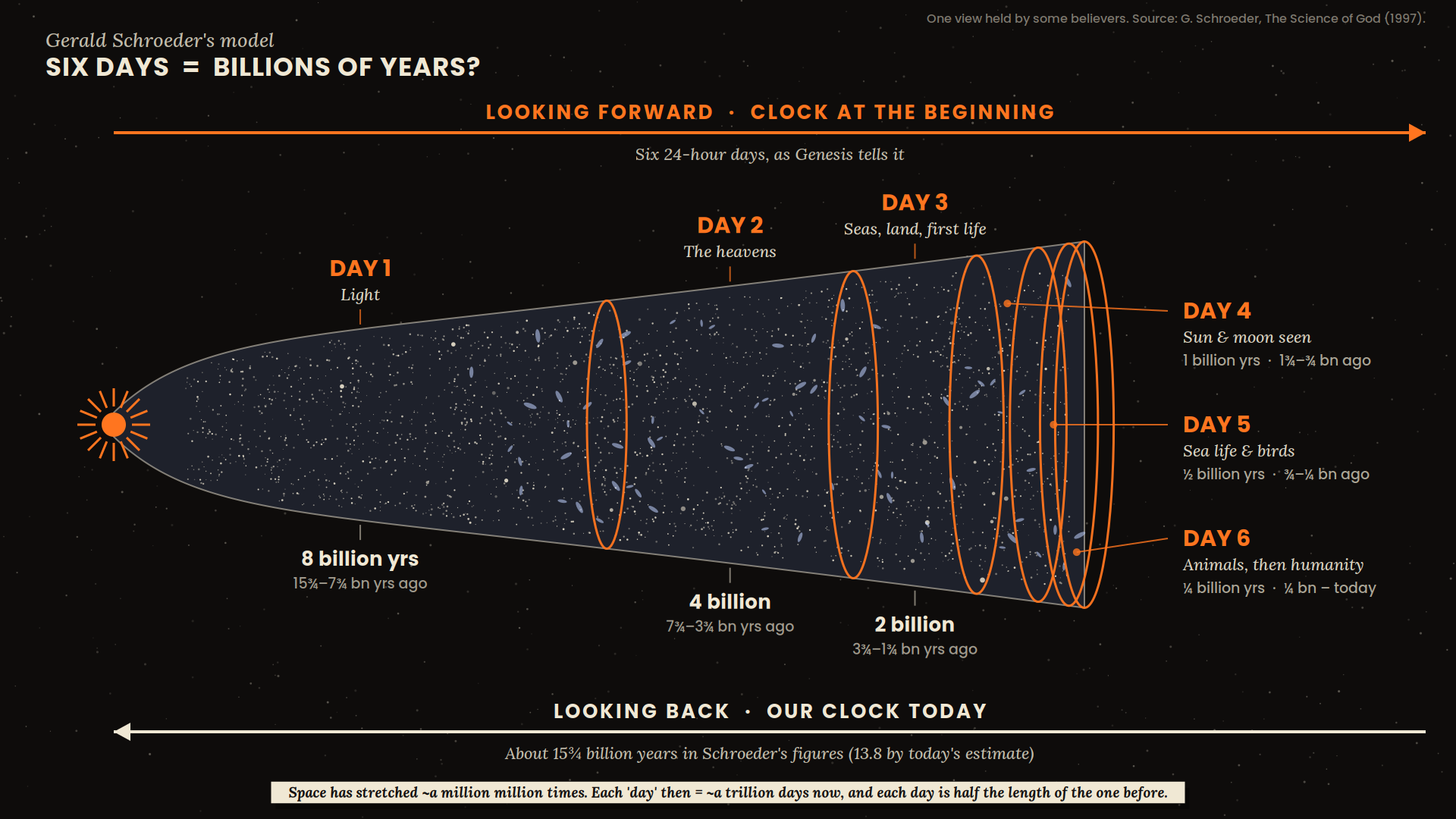
Because space has stretched roughly a million million times since the start, he argues, six days measured at the beginning correspond to billions of years measured from here. Schroeder worked from the older estimate of about 15 billion years. Physicists have debated whether his math holds, and he is not a Christian, but his work asks a fair question: from whose clock is the story told?
Major Christian bodies have chosen to hold these views together rather than force a verdict. The 1982 Chicago summit on biblical hermeneutics, which produced a statement on interpreting Scripture, affirmed that Genesis 1–11 is factual while taking no position on the age of the earth. In 2000 the Presbyterian Church in America's study committee recognized several readings of the days as within its confessional bounds.
What the telescopes are telling us
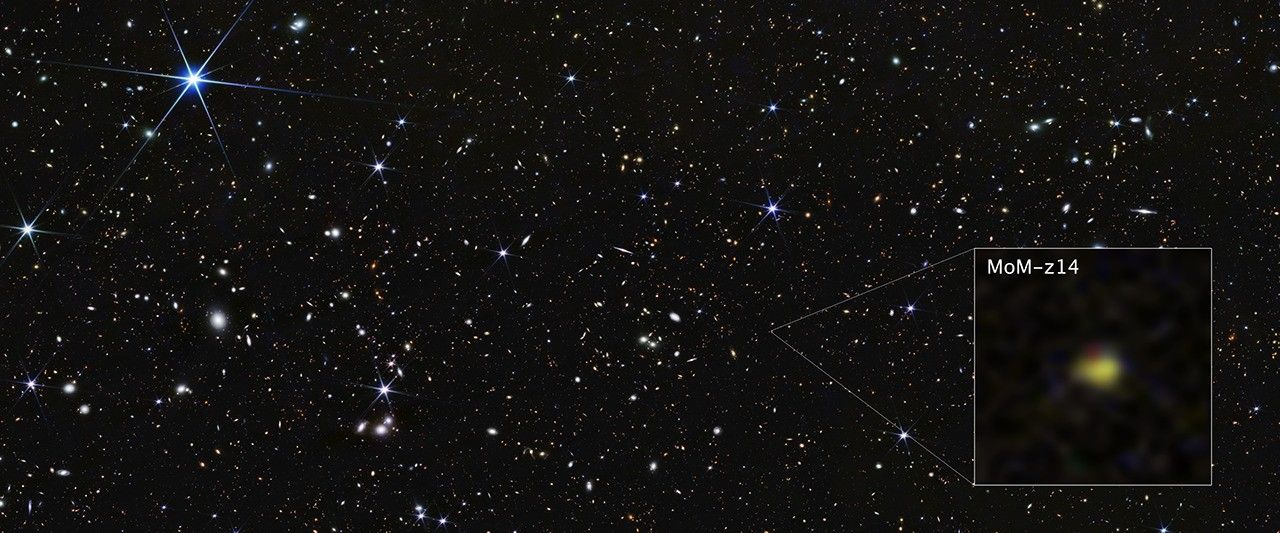
In January 2026, astronomers using the James Webb Space Telescope confirmed a galaxy called MoM-z14, seen as it was about 280 million years after the Big Bang, the most distant yet confirmed. What surprised them was not that galaxies existed so early, but how bright, how numerous, and how chemically developed they were. Bright galaxies like it appear about a hundred times more often than models predicted before Webb launched. The lead author put it plainly: the early universe "looks nothing like what we predicted."
There is a second open question as well. Measurements of how fast the universe is expanding disagree depending on the method used, a puzzle known as the Hubble tension.
What should a Christian take from this? Not that the universe is young, and not that the Bible has been proven. Webb is revising how galaxies formed, not overturning the 13.8-billion-year estimate. But it is a fair reminder that scientific models are provisional, held by people who are honest enough to say "we did not predict this." Christians on every side of this question can welcome that honesty. Our confidence rests in the Creator, not in the current model of creation, and not in our own reading of it either.
Why this does not divide us
There are three reasons.
First, no creed decides it. The church has defined the essentials with great care: the Trinity, the person of Christ, salvation by grace. On the age of the universe it has deliberately stayed silent.
Second, it is not a gospel issue. No one is saved or lost by their view of the calendar. A young-earth believer and an old-earth believer kneel at the same cross and are raised by the same Christ.
Third, the church has always held both. From Basil and Augustine to Warfield and Morris, faithful Christians have read these chapters differently while confessing the same Lord.
So debate it. Read the strongest case for the view you do not hold. Hold your own with conviction and humility. But do not break fellowship over it.
In essentials, unity; in non-essentials, liberty; in all things, charity.
---
United, Not Uniform · 01. Hear teachers from each view on the CF doctrinal map at thecf.online.